
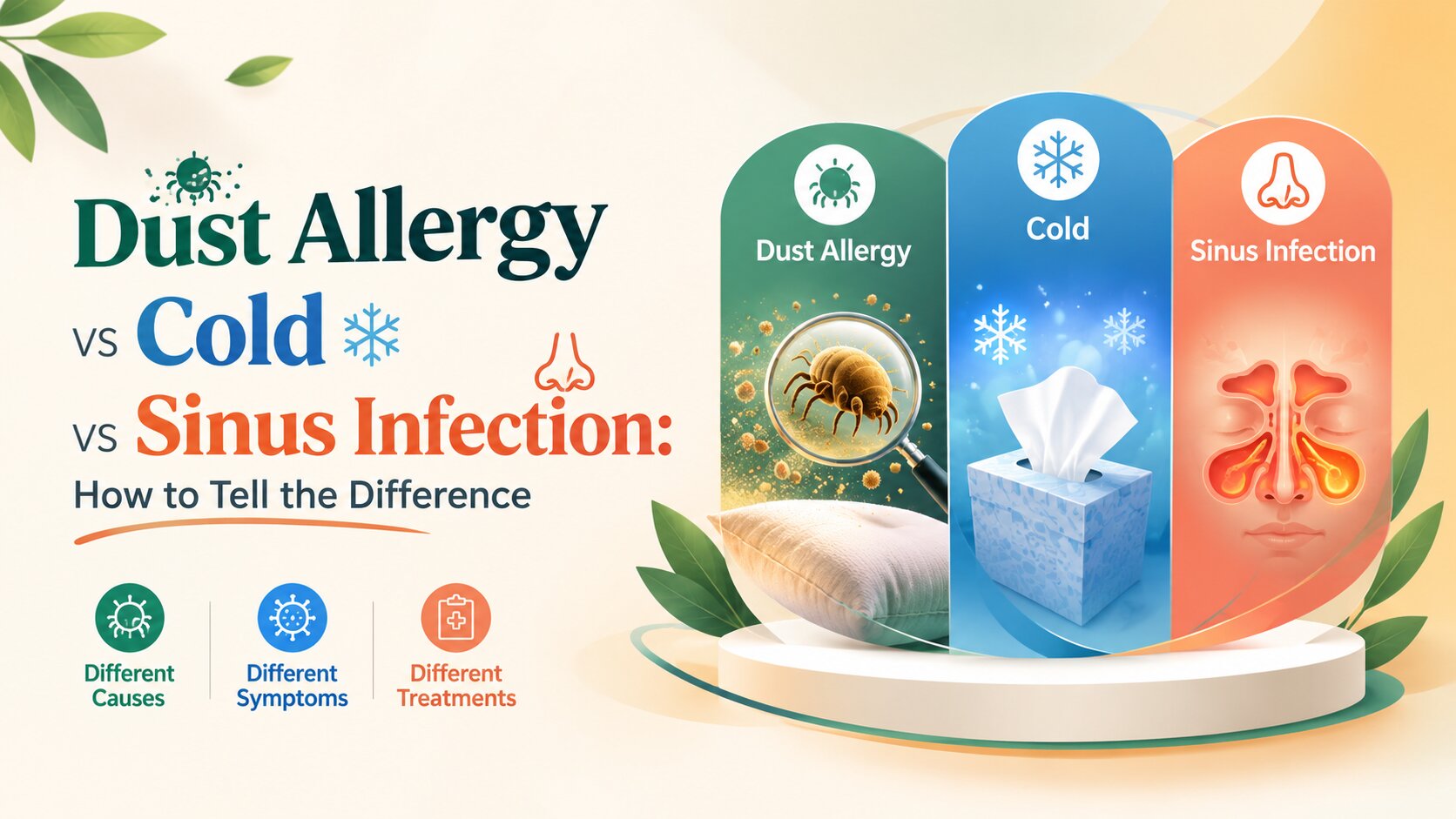
You wake up with a blocked nose and a scratchy throat. By afternoon, you are sneezing non-stop. Is it a cold? Is it the dust? Or is something worse brewing in your sinuses?
If you are stuck on dust allergy vs cold vs sinus infection, you are not alone. Every year, as the weather shifts in Delhi, our clinic sees patients who have guessed wrong. Some take antibiotics for an allergy. Others ignore a sinus infection for weeks. The three conditions overlap a lot, but they are not the same, and the right treatment depends on knowing which one you have.
This guide explains each condition in plain language. You will also learn simple clues to tell them apart and when it is time to see a doctor.
Why These Three Conditions Get Confused
All three affect your nose and sinuses. All three can cause congestion, a runny nose, headache, and tiredness. That is why so many people mix them up, especially during the change of season.
In Delhi, the confusion gets worse. Dust, construction particles, and smog stay in the air for months. As temperatures drop in October and November, viral infections also spread faster. So your nose is fighting dust and germs at the same time.
The good news is that each condition leaves its own set of clues. Let’s look at them one by one.
What is a Dust Allergy?
A dust allergy happens when your immune system overreacts to tiny particles in the air. These usually include dust mites, pet dander, mould spores, and pollen. Doctors call this allergic rhinitis.
Your body treats these harmless particles as threats. It releases chemicals such as histamine, and that causes your symptoms.
Common dust allergy symptoms
- Repeated sneezing, often in long fits
- Clear, watery nasal discharge
- Itchy nose, eyes, throat, or ears
- Watery, red eyes
- A blocked nose, especially in the morning
- Post-nasal drip that causes a tickly cough
Itching is the biggest clue. If your eyes and nose itch, an allergy is the most likely cause. A dust allergy also does not cause fever or body aches.
Symptoms usually appear soon after exposure. Cleaning the house, opening old cupboards, or sleeping on dusty bedding can set off a flare-up. And as long as you are exposed to the trigger, the symptoms continue for weeks or even months.
What is a Common Cold?
A cold is a viral infection of the nose and throat. More than 200 viruses can cause one, and you catch it from infected people or contaminated surfaces.
Common cold symptoms
- A sore or scratchy throat that appears first
- Sneezing and a runny nose
- Mucus that starts clear and may turn thick or yellowish
- Mild cough
- Body aches and general tiredness
- Sometimes a low-grade fever, more often in children
A cold comes on gradually. Usually the throat feels sore first, and the blocked nose follows after a day or two. Most colds peak around day three or four. After that, they improve and clear up within seven to ten days.
Colds also spread. If your family or colleagues are sniffling too, a cold is a strong possibility.
What is a Sinus Infection?
Your sinuses are air-filled spaces behind your forehead, cheeks, and nose. When they become inflamed and blocked, mucus gets trapped. Germs then multiply, and you get sinusitis, also called a sinus infection.
Here is what many people do not realise. A sinus infection often starts as a cold or an allergy flare-up. The swelling blocks the sinus openings, and the trapped mucus becomes a breeding ground for infection.
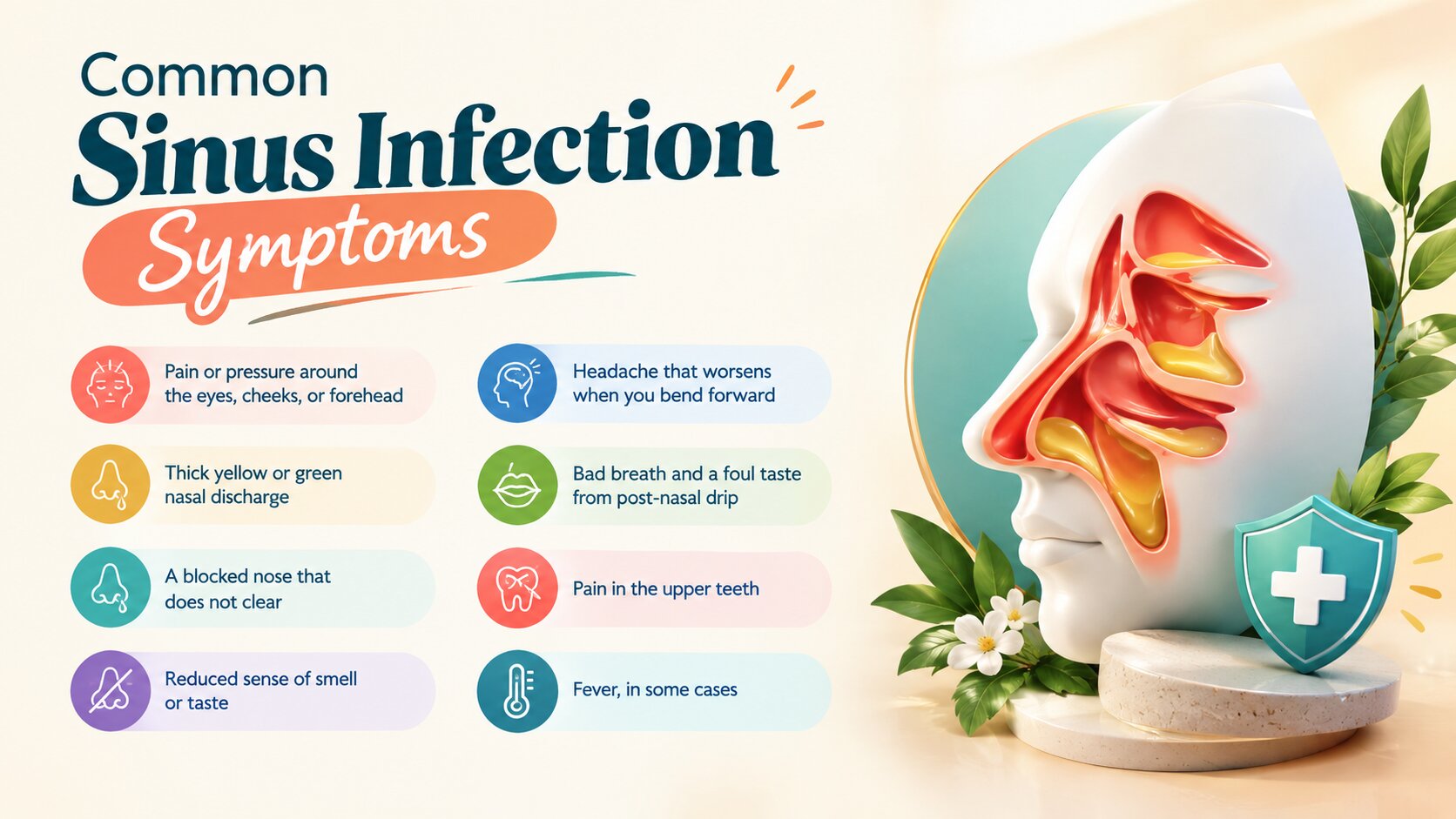
Common sinus infection symptoms
- Pain or pressure around the eyes, cheeks, or forehead
- Thick yellow or green nasal discharge
- A blocked nose that does not clear
- Reduced sense of smell or taste
- Headache that worsens when you bend forward
- Bad breath and a foul taste from post-nasal drip
- Pain in the upper teeth
- Fever, in some cases
Facial pain and pressure are the key clues. Neither a simple cold nor a plain allergy usually causes that heavy, aching feeling in the face.
Acute sinusitis lasts less than four weeks. If symptoms continue beyond 12 weeks, doctors call it chronic sinusitis, which needs proper medical evaluation.
Dust Allergy vs Cold vs Sinus Infection: Quick Comparison
Here is a simple way to compare the three.
|
Feature |
Dust Allergy |
Common Cold |
Sinus Infection |
| Cause | Immune reaction to allergens | Virus | Inflamed, blocked sinuses (viral, bacterial, or allergic) |
| Onset | Quick, after exposure | Gradual | Often follows a cold or allergy |
| Itching | Very common | Rare | Rare |
| Mucus | Clear and watery | Clear, then thicker | Thick, yellow or green |
| Fever | No | Sometimes low-grade | Sometimes |
| Facial pain | No | Mild at most | Common |
| Duration | Weeks to months | 7 to 10 days | 10 days or longer |
Three Simple Questions to Help You Decide
You do not need a medical degree to spot the pattern. Ask yourself these questions.
1. Is there itching? Itchy eyes and a nose that tickles all day point toward a dust allergy.
2. How long has it lasted? A cold improves within ten days. If you are still unwell after that, or if you got better and then suddenly got worse, think of a sinus infection.
3. Do you have facial pain or thick coloured mucus? Pressure around your eyes and cheeks, along with thick yellow-green discharge, suggests sinusitis.
Remember, these are only guidelines. You can have more than one problem at once. For example, an allergy can lead to a sinus infection.
How Each Condition is Treated
Treatment depends on the cause, which is why a correct diagnosis matters so much.
For a dust allergy, the focus is on avoiding triggers and controlling symptoms. Antihistamines and nasal sprays help. For people who suffer every season, an allergy skin prick test can identify exactly what triggers the reaction. Immunotherapy can then reduce the body’s sensitivity over time, which offers longer-lasting relief than tablets alone.
For a cold, rest, fluids, steam inhalation, and saline nasal rinses are usually enough. Antibiotics do not work on viruses, so taking them for a cold does more harm than good.
For a sinus infection, treatment depends on the cause. Many cases improve with saline irrigation, decongestants, and nasal steroid sprays. Antibiotics are needed only when a doctor confirms a bacterial infection. Repeated or long-lasting cases may need an ENT endoscopy to see what is happening inside the nose.
Simple Home Tips for Delhi’s Dusty Season
- Wash bedsheets and pillow covers weekly in hot water
- Use a damp cloth for cleaning instead of dry dusting
- Keep windows closed on high-pollution days
- Wear a well-fitted mask outdoors
- Drink plenty of water to keep mucus thin
- Try steam inhalation or saline rinses for temporary relief
When Should You See a Doctor?
Visit an ENT specialist if you notice any of these signs:
- Symptoms last more than 10 days without improving
- You get better and then suddenly worsen
- Severe facial pain or headache
- High or persistent fever
- Colds or “allergies” keep returning every few weeks
- Over-the-counter medicines no longer help
- Your sense of smell has reduced
Seek urgent care immediately if you have swelling or redness around the eyes, vision changes, severe headache with a stiff neck, or confusion. These can signal a serious complication.
Get Clear Answers at Taneja ENT & Eye Clinic
Guessing between a dust allergy, a cold, and a sinus infection wastes time and can prolong your discomfort. A proper examination often settles the question quickly.
At Taneja ENT & Eye Clinic, we use advanced ENT endoscopy and accurate allergy testing to find the real cause of your symptoms. Whether you are looking for an ENT specialist in Rohini, an allergy specialist in Delhi, or simply a reliable walk-in clinic, our team is here to help. We explain everything in simple language, so you know exactly what is happening and what to do next.
We have two branches, in Sector 24, Rohini, and Narela, and walk-ins are welcome.
Don’t let another season of sneezing and congestion slow you down. Call +91-8929925464 or +91-8512025606, or book your appointment online today.